Client
Jadu AR Inc.
Role
Head of Design
Work
Design Direction
User Interface
User Experience
Motion Design
Year
2023—2025
Context
How I helped Jadu transition from a Web3 experiment into a mobile gaming product company.
Jadu is an AR-focused startup that began as an NFT platform and evolved into a hybrid of tech and mobile gaming company.
When I joined, the team was talented and ambitious, but the product direction, workflow, and delivery model were heavily influenced by the pace and chaos of Web3 culture: rapid experiments, unclear ownership, and inconsistent development cycles.
Over time, our market really shifted – especially with AppStore constraints around NFT-based apps. The company needed to move from a speculative NFT ecosystem into a sustainable, player-focused mobile gaming product.
I played a key role in shaping this transition.
my role
Head of Design — Hands-on, strategic, and cross-functional.
① Led design across three major AR products: NFT Platform → Jadu Fight → Jadu Panic.
② Drove the shift from Web3-style experimentation into a proper sprint-based product organisation.
③ Introduced workflow clarity, design quality standards, and better communication rhythms with engineering and leadership.
④ Balanced hands-on IC work with design direction.
Challenge
Before
① Release cycles were reactive and feature-led rather than user-led.
② No unified product workflow or shared definition of "done".
③ High engineering dependence on ad-hoc decisions.
④ NFT-focused UX restricted distribution on AppStore.
⑤ Design had no predictable process for iteration, validation or handoff.
After
① Clear product pipeline and sprint rhythms.
② Predictable planning → execution → validation cycles.
③ Unified workflow across design, engineering and marketing.
④ Shift from "NFT-based AR experiences" to "products with AR", enabling speed on production and growth.
My objective wasn't just to design screens, but to design how the company builds products.
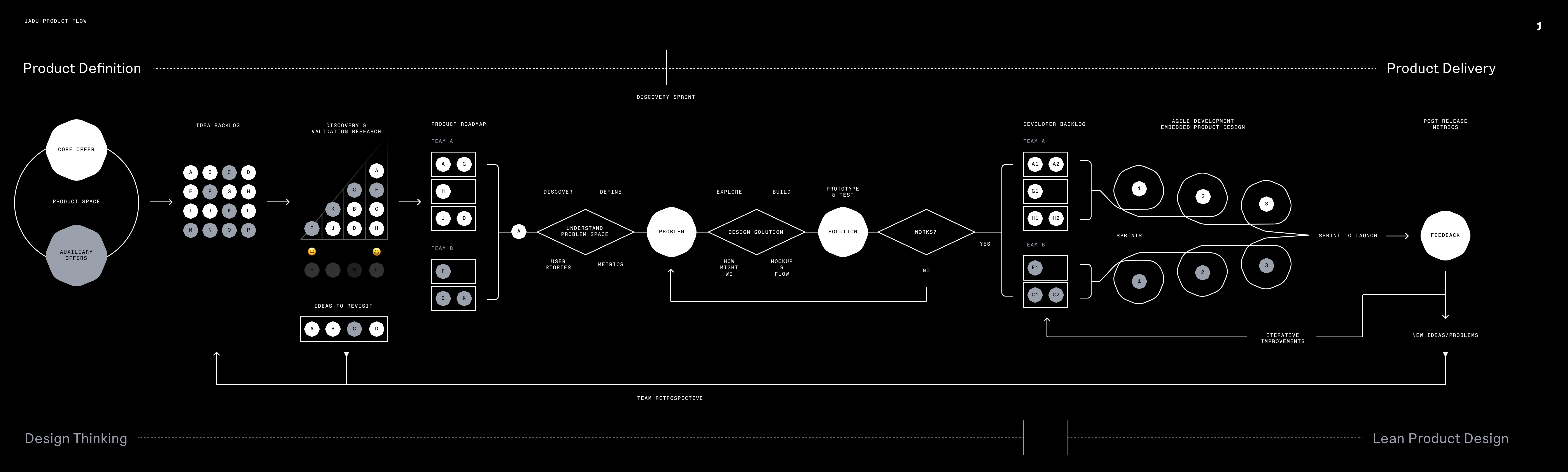
product workflow
A workflow that aligned the entire company
To bring clarity across teams, I introduced a product development framework that defined how ideas move from discovery to launch.
The workflow aligned:
① Design (research, prototyping, user experience, visual direction).
② Engineering (feasibility, sprint execution, QA).
③ Product (scope definition, prioritization, iteration loops).
④ Marketing/Community/Brand (content, tournaments, feature validation).
This structure enabled us to shift from irregular, intuition-led releases to repeatable, measurable product cycles. It became the backbone for shipping both Jadu Fight and Panic at speed and with good craft.
Below you can see more details about the products — ① Panic, ② Fight, ③ NFT Platform — I helped Jadu create. ↯
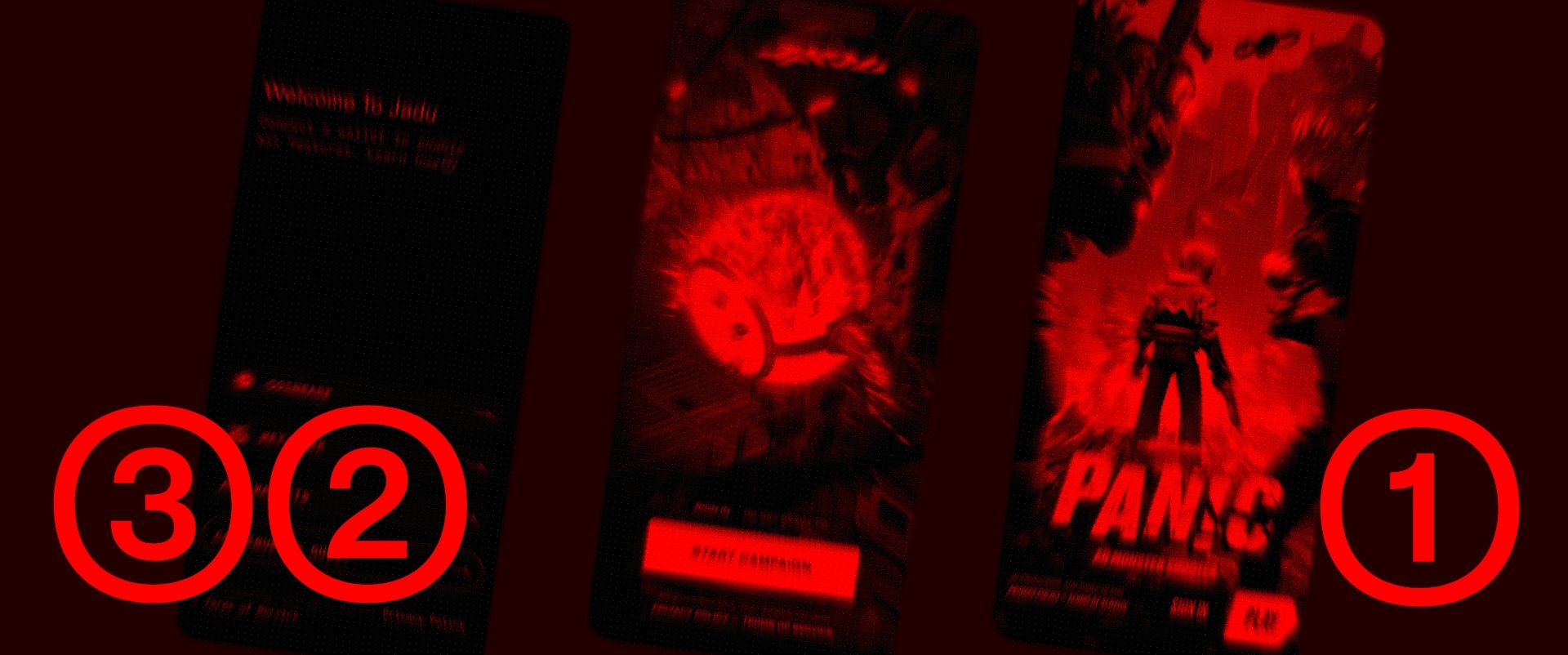
① Panic
A first-of-its-kind AR shooter.
Jadu's most mature product and the culmination of our product evolution.
A polished single-player AR shooter with a world map, refined mechanics, progression systems, and a stronger brand direction.
② Fight
Our pivot into mobile gaming.
A multiplayer AR fighting game with a new gaming visual language, a character creator, community tournaments, and the first iteration of our event-based live ops.
③ NFT
AR experience built on users' existing NFT avatars.
Users could import NFTs via wallets like MetaMask and control them in AR with movements, emotes and equip objects such as Jetpacks and Hoverboards.
This was the foundation of our early user base and community.